

Why a proper inventory matters
After a fire or flood, homeowners often want to start cleaning up right away. That impulse is understandable, but it leads to a serious problem: without a documented inventory of damaged belongings, proving the actual scope of your losses becomes nearly impossible. Restoration companies follow a structured process for cataloging everything in your home before any cleanup or removal begins. Understanding how this process works helps you protect your interests and avoid costly mistakes.
A professional inventory serves several purposes at once. It creates a record for your insurance claim. It establishes which items can be restored and which cannot. And it provides a chain of custody — from the moment your belongings leave the house until they come back. For Del Mar homeowners dealing with coastal moisture damage or fire, this documentation often determines whether a claim gets paid in full or disputed for months.
The initial inspection and damage report
The process starts with an on-site inspection. A specialist arrives at the property, walks through every room, and composes a detailed inspection act. This document records the date and time of the visit, the exact address, the names of everyone present during the inspection, and a description of what happened — the cause of the damage and its visible consequences.
For each room, the report notes the condition of walls, ceilings, and floors, measuring damaged areas in square feet. Structural damage to finishes — peeling paint, warped flooring, stained drywall — gets recorded with precise dimensions. But the report goes beyond the structure of the house itself. Every damaged item of personal property is listed: furniture, appliances, electronics, clothing, documents. For each item, the report includes identifying characteristics and the degree of damage.
The inspection act must be signed by all parties present. If the homeowner, the restoration company representative, or a property manager refuses to sign, that refusal is noted directly in the document. Three copies are typically produced — one for the homeowner, one for the restoration company, and one for the insurance adjuster or property management.
How each item gets documented
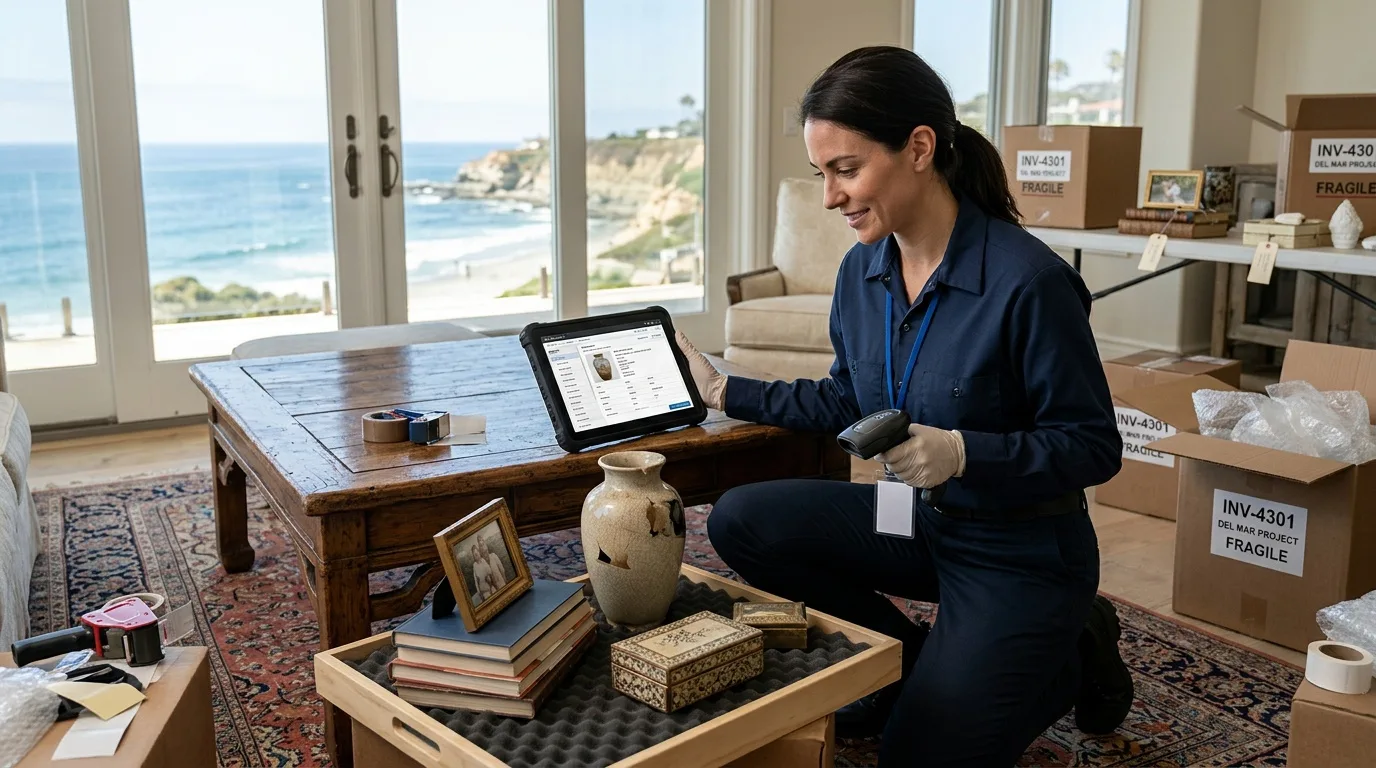
The inventory itself follows a specific methodology. For every item in the affected area, the restoration team records the name, manufacturer, model number, and serial number when visible. The degree of damage is classified into categories: totally destroyed, requires professional restoration, needs cleaning only, or undamaged but requires removal for safety during repairs.
Photographic documentation uses four distinct angles for each item or group of items. First, a wide shot showing the entire space — this establishes context and lets the viewer see where the item was located relative to the room. Second, a medium shot of the individual item, capturing its overall condition. Third, a close-up that records serial numbers, brand labels, or specific damage marks like char patterns, water lines, or mold growth. Fourth, a location reference shot that includes surrounding objects for scale and orientation.
This four-angle approach is not arbitrary. When an insurance company reviews a claim months later, or when a dispute ends up in front of an adjuster, these photographs become the primary evidence. A single photo of a smoke-damaged sofa proves little. Four photos showing the sofa in context, the extent of discoloration, the manufacturer label, and the soot pattern relative to the nearest wall — that tells a complete story.
Room-by-room cataloging
Restoration crews work through the house systematically, usually starting with the most damaged area and moving outward. In each room, they document the structural damage first — ceiling, walls, floor — then move to fixed installations like cabinetry and built-in shelving, and finally to movable property.
Categories of movable property typically include furniture (bedroom sets, tables, chairs, sofas, shelving units), electronics and appliances (televisions, computers, kitchen equipment, audio systems), clothing and textiles (wardrobes, linens, curtains, rugs), decorative items and artwork, documents and books, and miscellaneous household goods. Each category gets its own section in the inventory, which makes it easier to cross-reference with insurance policy limits that often cap coverage by category.
In Del Mar homes, coastal factors add particular complications. Salt air accelerates corrosion on electronics and metal fixtures after water intrusion. Humidity-sensitive items like wooden furniture, musical instruments, or leather goods may show damage that is not immediately visible but develops over days. A thorough inventory notes not just current visible damage but also flags items at risk of delayed deterioration — these get marked for follow-up inspection.
Packing, labeling, and chain of custody
Once the inventory is complete, items designated for off-site cleaning or storage are packed by the crew. Each box receives a number, and the contents of every box are recorded in a numbered list with a brief description of what is inside. Color-coded labels often indicate destination: items going to textile cleaning, items going to electronics restoration, items going to climate-controlled storage, items being returned directly to the homeowner.
The packing process itself follows specific rules depending on the type of item. Heavy objects like books go into small boxes — no more than about 30 pounds per container. Fragile items are wrapped individually in protective material, with padding between layers. Clothing goes into wardrobe boxes on hangers when possible. Electronics are wrapped separately with anti-static material when available.
At the point of removal from the property, the homeowner signs a transfer document — essentially an acceptance act that lists every box and loose item being taken. From this moment, responsibility for the condition and safety of the belongings transfers to the restoration company. This document is critical. It gives the homeowner the legal basis to claim compensation if anything is lost or further damaged while in the company's possession.
The role of independent assessment
In many cases, homeowners also hire an independent appraiser to verify the restoration company's inventory or to prepare a separate damage valuation. The independent specialist visits the property, conducts their own measurements and photography, and looks specifically for hidden defects that a standard inventory might miss — damaged wiring inside walls after a fire, foundation issues from prolonged water exposure, mold colonies forming behind intact-looking drywall.
The independent assessment follows a defined sequence. The homeowner gathers property documents — ownership records, any prior appraisals, receipts for major purchases. The appraiser visits the site, inspects all accessible spaces, and uses specialized tools to detect moisture or structural compromise that is not visible to the eye. After the visit, calculations are performed using current replacement costs, and a written report is delivered with a specific dollar figure for the total loss.
For Del Mar properties, independent assessment is particularly worth considering when the damage involves both the structure and contents, or when the insurance company's initial estimate seems low. The appraiser's report carries legal weight and can be used in negotiations or, if necessary, in court proceedings.
Common mistakes homeowners make
The most frequent error is starting repairs or cleanup before the inventory is complete. Once you move or discard damaged items, the evidence of their condition disappears. Even well-intentioned cleanup — mopping water, throwing away charred materials, airing out smoke-damaged rooms — can compromise the documentation that your claim depends on.
Another common mistake is failing to include items in the inventory. People forget about contents of closets, garage storage, attic items, or things that were in drawers. Restoration companies work to be thorough, but they are documenting a stranger's home. The homeowner should walk through the inventory with the crew and point out anything that might be overlooked — items stored under beds, valuables in safes, collections kept in less obvious places.
A third mistake is not keeping your own copies. The restoration company maintains their inventory, and the insurance company receives a copy, but the homeowner should have an independent record — ideally their own photographs and a personal list made before or alongside the professional inventory. If the company's records are ever incomplete or disputed, the homeowner's own documentation serves as a backup.
Finally, many homeowners overlook the importance of timing. The first 48 hours after the damage occurs are the most critical window for documentation. Evidence degrades quickly — water evaporates, soot spreads, mold begins growing. Mold in a damp home also brings health risks for the people living there. The sooner the professional inventory begins, the more accurate and defensible it will be.
What to expect from the process
A full inventory of a typical Del Mar home — three bedrooms, standard furnishings — generally takes a crew of two to three people the better part of a day. Larger homes or severe damage may require two days or more. The inventory document itself, when completed, runs anywhere from several pages for a lightly affected property to dozens of pages for a fully involved fire or major flood.
The finished inventory becomes part of your insurance claim file. It is referenced when the adjuster calculates your settlement, when the restoration company tracks items through cleaning and storage, and when belongings are returned to you after repairs are complete. Each item on the list has a recorded status — and when it comes back, that status is updated to reflect whether it was successfully restored or needs to be replaced.
For homeowners in Del Mar, where property values and the cost of personal belongings tend to be significant, a well-executed inventory is not just paperwork. It is the foundation of a fair recovery. The more you understand about how the process works, the better positioned you are to make sure nothing falls through the cracks.
By the way, our parent company covers Del Mar and the rest of the county — the full story is on our main site's Del Mar section.