

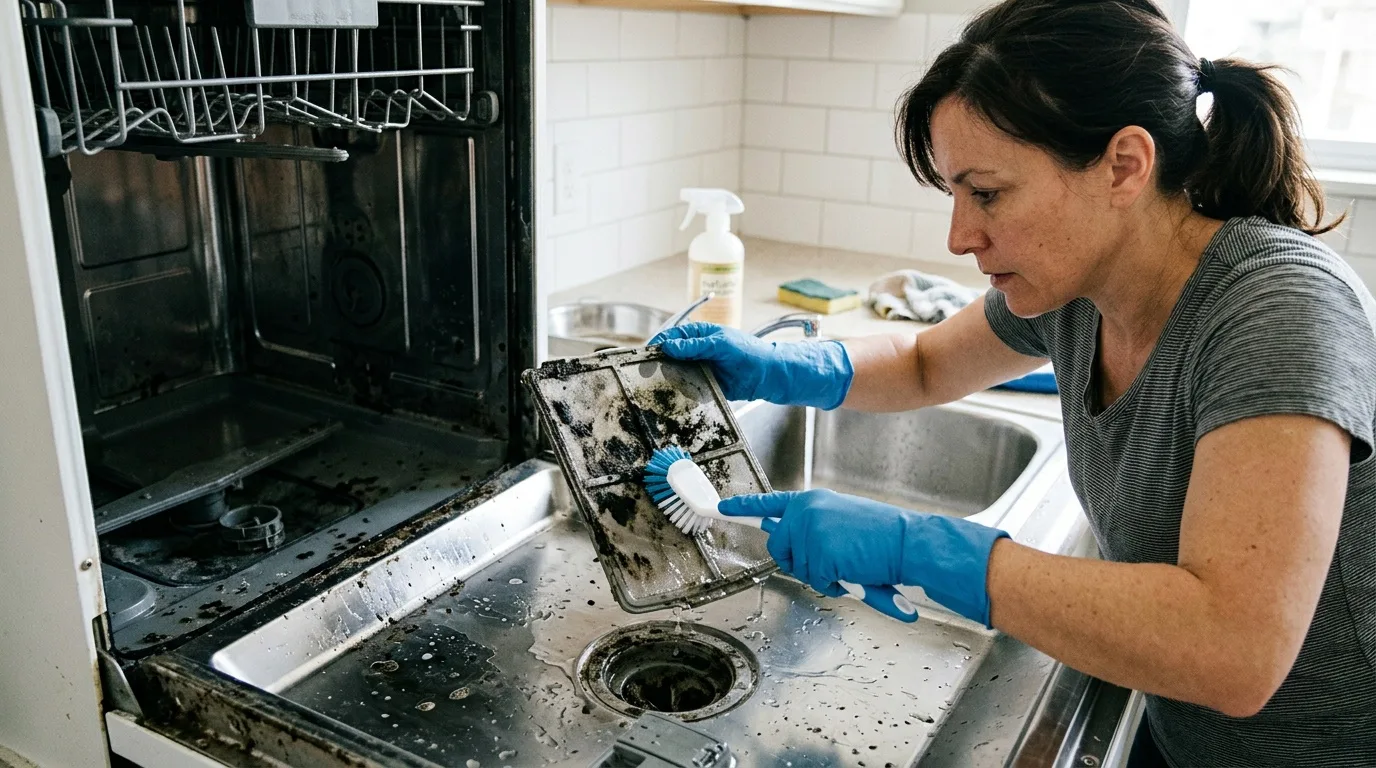
Food particles, grease and other organic dirt can stay inside parts that are easy to overlook. And since a dishwasher is warm and humid inside, over time they start to give off an unpleasant smell. Moisture and organic leftovers make an ideal environment for bacteria and mold. The result is a musty or rotten odor in the tub, which over time begins to pass to the dishes.
Before you use harsh cleaners or take the appliance apart, it is worth trying a few simple steps. Regular care will also help keep the smell from coming back.
Manufacturers advise cleaning the machine about once a month. But this is a general recommendation. In your case the unit may need washing more or less often. It depends on how exactly you are used to running it.
Keep in mind that the machine gets dirty faster if:
- You run it often. Once a day or more.
- You forget to leave the door open after a wash. In that case the inner parts take longer to dry and mold can appear on them.
- Your water is very hard, but you do not use a detergent or rinse aid made for hard water.
- You load very dirty dishes with burnt food, set grease, dried bits of dough.
- You wash at a low water temperature, for example to save on electricity.
- You only use gentle detergents that simply cannot remove heavy soil.
How to Tell the Dishwasher Needs Cleaning
Here are the main symptoms:
- Smell. An unpleasant odor from the wash tub.
- Poor washing. Plates, pots and cups come out with whitish water marks or a greasy film.
- Food bits. You see particles of food inside the tub or on the dishes you take out.
- Deposits. Rust and mineral buildup are visible on the inner surfaces.
- Stubborn film. The filter and spray arms have a coating that does not rinse off.
- Slow drain. Water leaves more slowly than usual.
If any of these signs shows up, the machine clearly needs a full cleaning. Work in order.
Where Mold Grows in a Dishwasher
Mold in the Dishwasher Filter
Some manufacturers recommend cleaning the filter after every wash. The point is that the filter system holds back food particles so they do not block the drain. If this debris is not removed in time, it decays and can cause a bad smell. Dirty filters also make it harder for water to drain from the machine.
- Turn the power off. Unplug the dishwasher or switch off its circuit breaker and close the water supply valve.
- Take the filter out. Pull out the lower rack and find the filter. It is usually under the lower spray arm. How to remove it correctly is best checked in the manual for your model. On a modern dishwasher it is enough to pull it up slightly or unscrew it. On older models you may need a screwdriver.
- Wash it. Remove the largest food bits and other debris, for example pieces of plastic dishware. Rinse under warm running water or clean it with warm soapy water. A soft toothbrush helps remove food and grease from the mesh and the housing. For old grease you can soak the filter for 15-20 minutes in warm water with a few drops of dish soap or in a weak vinegar solution. Do not use abrasive sponges or metal brushes, they can damage the mesh.
- Put it back. Let the filter dry and then set it in place. Make sure the marking arrows on the bottom of the dishwasher and on the filter point at each other after installation.
Spray Arms
Food bits and mineral deposits can clog the small holes in the spray arms, so water circulates worse and a bad smell may appear. Look over the holes the water comes out of. If you see dirt or food, try to remove it with tweezers or a toothpick. But never push the debris into the nozzles!
If the parts are very dirty, remove the lower and upper spray arms as the machine's manual says. Most often the upper arm unscrews, and the lower one comes off if you carefully pull it up. Rinse them under warm running water, using a sponge if needed. Then wipe them and put them back. Check that they turn freely.
Mold in the Dishwasher Seal and the "Dead Zone"
Grease, food and other debris collect not only on filters and open surfaces but also in hard-to-reach places. For example, on the rubber gaskets between the door and the body. Debris can also get into the lower part of the door, the so-called dead zone, where water does not reach during a wash. The rubber seal around the door keeps the tub tight. Moisture and organic leftovers gather in its folds and make an ideal place for mold.
- Prepare a solution. Dampen a soft cloth in water and vinegar (1:1) or use a dedicated product. For disinfection and mold removal, a few drops of hydrogen peroxide can be added. Avoid chlorine products: they can damage the rubber and make it crack.
- Wipe the seal. Go carefully, including the folds. Pay special attention to the bottom of the door and the corners, where moisture collects most often. If you find black spots of mold, put on gloves and treat them with a baking soda solution (2 tablespoons per cup of water) and leave it for 10-15 minutes.
- Get into the grooves. A cotton swab or a toothbrush is handy here. Go around the whole perimeter. Do not stretch the seal too much, this can break its tightness.
- Dry it. After treatment, wipe the seal dry and leave the door open to air out.
Mold can also live in the detergent dispenser. Remove the dispenser and rinse it with warm water with some vinegar added. Pay special attention to the moving flaps.
Mold in the Dishwasher Drain Hose
If water stays on the bottom of the dishwasher after a cycle ends, the problem may be in the drain, not in dirt. A clogged drain or a wrongly installed drain hose can cause dirty water to stay inside the machine or come back in. Check the drain for visible dirt.
If the smell stays after a full cleaning, check the drain hose: water may be standing in it because it was connected wrong (no air gap or the wrong loop height). The drain hose should rise in a high loop, to the height your manual gives, before it connects to the sink drain or disposal. A little water also stays in the bottom of the tub after each cycle. If the machine is not used for several days, this water can go bad. Run a short rinse before a long break.
How to Clean Mold in a Dishwasher
The frequency of care depends on the part.
- Every day. After a cycle ends, wipe the door, especially the rubber seal. Leave the tub open. This helps prevent smell and mold.
- Once a week. Check and clean the filter. A clogged filter is one of the most common reasons for poor washing and a bad smell. With heavy use (2-3 cycles a day) the filter should be checked every 3-4 days. Wipe the door, the seal and the detergent compartment with a damp microfiber cloth or a sponge.
- Every month. Do a full preventive cleaning: use a dedicated cleaner, run an empty cycle, treat the door parts.
The Cleaning Cycle
This is the final part of the cleaning. It makes sense to start it only if you are sure the other parts of the dishwasher have no heavy dirt left. Most often manufacturers recommend only special dishwasher cleaners. They remove grease, film, mold and rust most effectively and most safely. These can be bought in ordinary supermarkets. As a rule it is a plastic container with liquid sealed under a membrane that dissolves in hot water. There are also tablet versions.
Place the cleaner in the dishwasher as its instructions show. Choose the longest, hottest cycle your machine has, such as Heavy or Sanitize. Run it with no dishes. Do not add regular detergent, it will make too much foam.
If there is no store cleaner but the machine needs cleaning, some people use plain white vinegar and baking soda. Put a glass cup in the lower rack and pour vinegar into it, close the machine. Run a full cycle. When it ends, take out the cup and sprinkle baking soda on the bottom of the dishwasher. Keep the machine closed for at least a few hours, for example overnight. In the morning run another full cycle.
Always unplug the dishwasher or switch off its breaker before you pull the filter or wipe the seals: doing it with the machine connected risks electric shock. Do not mix vinegar with chlorine products, the reaction gives off a toxic gas that is dangerous to breathe.
Leave the Door Ajar
After a cycle ends, leave the dishwasher door slightly open when you can. Air circulation lets the inside dry faster and keeps moisture from building up. This lowers the chance of a bad smell between washes. Open the door by hand 2-4 inches right after the program ends and leave it like that until the tub is fully dry, usually 2-3 hours. Some newer models open the door on their own after drying.
In summer, when the room is warmer and more humid, the risk of bacteria and mold goes up. In this period pay special attention to drying the seals and the corner zones of the tub.
When a Musty Smell Points to Water Under the Cabinet
If none of the methods above removed the smell, the problem may be standing water in hidden cavities of the unit or a faulty check valve on the drain hose. The design of the dishwasher affects its care. Built-in models set into the kitchen cabinets have limited access to the back panel and side walls, which makes it hard to see the condition of the hoses and connections. If you suspect a problem there, have an appliance technician pull the unit out and look over the lines.
When a dishwasher smells musty and the tub itself is clean, the smell may be coming from wet materials around it. Mold that has grown into the cabinet base, subfloor or wall is a separate job from cleaning the machine. Our page on mold remediation in Del Mar homes describes that work, and the page on water damage restoration and drying covers what happens when water has soaked into the cabinet and floor. For general background, read the EPA's guide to mold and moisture and our article on the health risks of living with mold.
Prevention
To keep the machine working longer without trouble, follow simple rules of care:
- Do not overload the racks. Tight loading blocks water flow and raises the risk of clogs. Place pots and pans upside down or at an angle so water does not collect inside.
- Clean the filter and spray arms regularly. It takes no more than 10 minutes a week but saves many problems.
- Do not shut the door tight after a wash. Let the moisture evaporate, this prevents mold and a musty smell.
- Run an empty cycle with cleaner once a month. If the machine is used rarely (1-2 times a week), once every 2 months is enough. With daily use, increase it to once every 2-3 weeks.
If you want to know who is behind this blog, see about our Del Mar restoration team and what local homeowners wrote in reviews. More articles on water, fire and mold are in the restoration news and tips blog, and when a whole room has to be emptied during work, the contents pack-out services page explains how belongings are handled. The full list of services is on the Del Mar restoration home page.