

Fire spreads faster than it seems. Most home fires develop in just a few minutes, and the first seconds decide a lot. The fire alarm system is what lets people in an apartment or a house react to a fire in time, and the smoke detector is the most important part of that system.
What is this device, and how does it work? Where to put smoke detectors in a house, in which rooms, and how to mount them? How often to replace smoke detectors? Below is a plain answer to each question, for a Del Mar home or any other California home.
What a Smoke Detector Is and How It Works
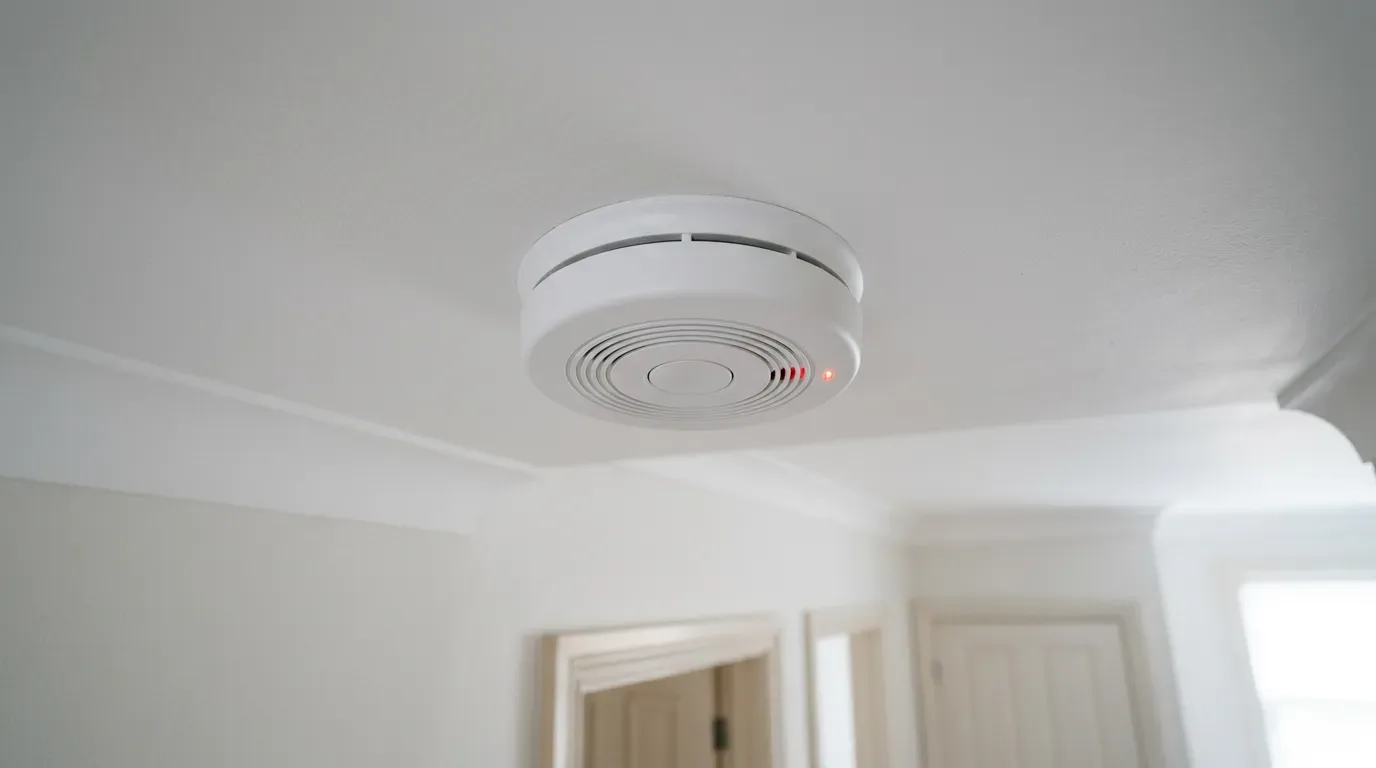
A smoke detector is a small device, usually in a plastic housing, that is mounted in a room to catch smoke at an early stage and warn about it with a sound and a light signal. Such devices are also sometimes called smoke sensors. Modern models can even send a notification to a smartphone, or a vibration signal to a special pad or to the headboard of the bed.
There are different kinds of detectors built on different mechanisms. But the basic scheme of operation, whatever the device, usually looks like this:
- Scanning. The air in the room is scanned.
- Analysis. The data is compared with the threshold values set in the program.
- Alarm. If the concentration of smoke in the air reaches the trigger level, the alarm goes off.
Types of smoke detectors
By power source, detectors are divided into stand-alone ones (running on batteries) and ones connected to household wiring. By how they respond, the main types are:
- Optical (photoelectric). They react to smoke particles and suit living rooms well, where a fire most often starts with smoldering.
- Ionization. They react faster to open flame, but give false alarms in the kitchen more often.
- Combined. The best option, as they pick up both types of fire.
Many new detectors connect to a smart home system and send a notification to the phone. This is especially convenient if you are often away from home or want to keep an eye on the safety of elderly relatives.
Why One Smoke Detector Is Not Enough
Many people think a single device can protect the whole house. But smoke does not spread evenly. It rises, collects under the ceiling, and may take a long time to reach the far rooms. If a fire starts at night in the kitchen and the only detector is in the hallway, precious minutes can be lost.
Even a small apartment has a bathroom, a hallway and a kitchen. So one detector is too few even in a small studio.
The U.S. Fire Administration recommends one detector on every level, including basements, plus one in every bedroom and one outside each separate sleeping area. This matters most if bedroom doors are closed at night, because then smoke may get inside too late.
The U.S. Fire Administration advises: install smoke alarms in every bedroom, outside each separate sleeping area and on every level of the home, and interconnect them so that when one sounds, they all sound.
Where to Put Smoke Detectors in a House
How many detectors for different homes
- One-bedroom apartment. At least two devices, in the bedroom and in the hallway outside it; the rest depends on the layout of the rooms.
- One-story house of about 1,000 square feet. At least three detectors: in the shared hallway outside the bedrooms, in the living room or the kitchen (but not right over the stove, to avoid false alarms) and in each bedroom.
- Two-story house. Several devices: one on each floor in the common area and one in each bedroom. If there is a basement or a finished attic room, put one there too, because wiring and heating equipment can become a source of fire.
Why does the right number really save lives? Several alarms raise the chance that smoke is heard in time. This is especially important at night, when people are asleep and do not notice smoke. A detector in every bedroom and on every level gives precious seconds for getting out.
For the garage, the U.S. Fire Administration recommends a heat alarm instead: smoke alarms are not designed for garages and go off there from temperature changes, dust and fumes.
Smoke alarm placement in the bedroom
A detector inside the bedroom and one in the hallway outside the sleeping area work together. The first catches a fire that starts in the room itself. The second catches smoke coming from the rest of the house before it gets under a closed door.
Ceiling or wall
Placement matters as much as the number. Smoke rises, so detectors go on the ceiling or as high on the wall as possible. When choosing the spot, keep to these rules:
- Away from corners. Do not tuck the device into the corner where the wall meets the ceiling; the air there barely moves. Best of all is the center of the room.
- Away from vents and windows. Do not place the detector within about 3 feet of a supply vent. Air flow near vents, windows and range hoods can "knock" smoke away from the detector.
- Away from light fixtures. Keep the smoke detector some distance from a light fixture; the manufacturer's instructions give the spacing.
- Sloped ceilings. If the ceilings are sloped, the alarm goes within 3 feet of the peak, a few inches down from the very top. That is where smoke goes first.
Where to Put Smoke Detectors in the Kitchen and Near the Bathroom
A detector in the kitchen should not go off from ordinary cooking. That is why it is not mounted right over the stove. Ionization models in the kitchen give false alarms more often than optical ones.
Steam is the other problem. A ventilation system can carry dust, fibers or steam that the detector mistakes for smoke. For example, steam from the bathroom can easily set off a detector if it is placed near a vent.
Why a detector near a vent goes off
- Air currents. When the detector is near a vent grille, air currents create turbulence around the device. Fine particles of dust, fibers or steam get pulled into the detector chamber. Optical sensors, which react to scattered light, take these particles for smoke.
- Temperature swings. If the ventilation heats or cools the air, this changes the temperature around the detector. Some sensitive devices react to such changes as a sign of fire.
- Chemicals in the air. If the ventilation carries chemical vapors, for example from cleaning products or paint, the detector can take them for products of combustion.
- Worn components. Even if the detector is placed correctly, wear of internal parts, such as a clogged optical sensor or faulty electronics, can lead to false alarms. A clogged sensor blocks the passage of light, and the detector reads this as smoke.
The fix: move the detector
The best solution is to move the smoke detector away from the vent grille, at least the 3 feet given above. This keeps air currents and the particles they carry from reaching it. If moving it is not possible, ask the manufacturer which model suits that spot. Never disable or cover an alarm to stop false alarms.
A common mistake is trying to solve the problem without moving the detector. A false alarm is not just an annoyance. When a device goes off for no reason, people stop trusting the system, and in a real emergency that can cost a lot.
Interconnecting Smoke Alarms
Real protection comes not from one device but from a system where each device watches its own part of the house. The U.S. Fire Administration recommends interconnecting smoke alarms so that when one sounds, they all sound. A fire in the garage at night is then heard in the bedroom upstairs, not only in the garage.
Hardwired alarms are interconnected through the wiring. Wireless and smart models link over radio, and some send an alert to the phone as well.
How to Install a Smoke Detector
- Choose the spot. Pick the location following the rules above.
- Turn off the power. This applies to hardwired detectors; their wiring is a job for a licensed electrician.
- Mount the bracket. The mounting bracket lets you remove the device easily when it needs repair or a battery change. For hardwired detectors, the bracket goes on a pre-installed electrical box.
- Attach the detector. The detector itself is fixed to the bracket.
- Run a test. There is usually a special button on the device for this. If the signal does not sound during the test, either the device was installed wrong or it is defective.
Testing and Maintenance
Even the best detector is useless if it does not work. The U.S. Fire Administration advises testing every alarm once a month; pressing the "test" button is usually enough. In California, battery-only alarms sold since July 1, 2014 have a sealed battery that lasts 10 years, so there is nothing to change: when it runs down, the whole alarm is replaced. In older alarms with a 9-volt battery, and for the backup battery in hardwired alarms, the battery is replaced once a year. Clean the dust off every alarm. Some models have self-diagnostics and signal on their own when they need service.
How Often to Replace Smoke Detectors
According to the U.S. Fire Administration smoke alarm page, smoke alarms should be replaced 10 years after the date of manufacture. The date is printed on the back of the device. The count starts from that date, not from the day the alarm was put on the ceiling.
An old detector can fail in both directions. Worn components cause false alarms, and a sensor that has aged may react to real smoke later than it should.
After a Fire: Smoke Alarms and Smoke Damage
After a fire, smoke and soot settle on every surface, including the detectors that stayed on the ceiling. Dust and particles in the chamber are one of the causes of a clogged sensor, so every alarm in the home should be tested again, and alarms older than 10 years replaced.
Smoke damage to the rest of the home is a separate job. It is covered on our fire and smoke damage restoration page. Belongings that need to be cleaned or stored while the house is restored go through our pack-out and contents services, and our guide on how restoration companies inventory your belongings explains how items are listed. Water used to put out a fire often leaves its own problem, described on the water damage restoration services page.
You can read more about our restoration team, see what homeowners say in reviews, or browse more home safety articles on our blog. All services are listed on the Del Mar restoration company home page.
One level, one detector at minimum. Every bedroom should be covered. Add regular testing and attention to small things, and a fire is less likely to catch the household off guard.