

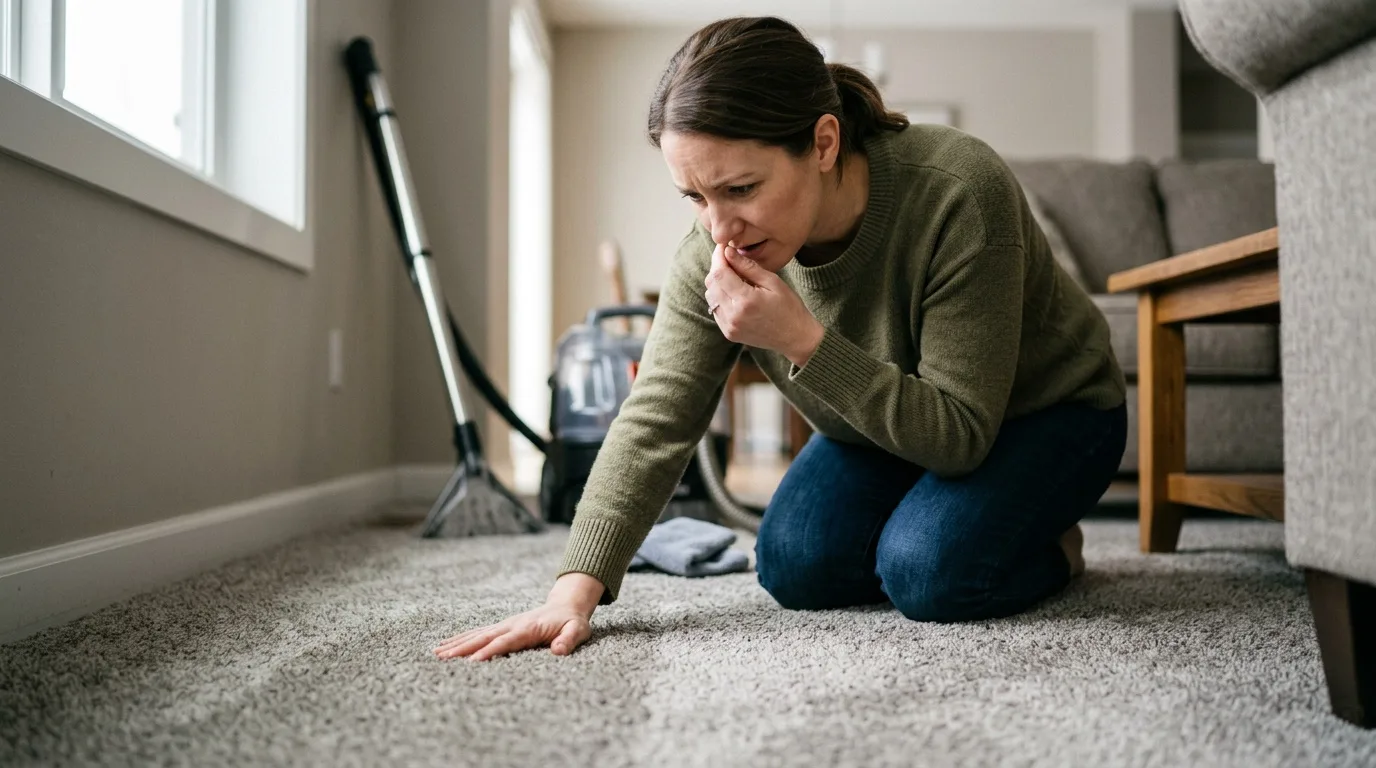
A carpet has been cleaned, it looks fresh, and a day later the room smells damp. Many Del Mar homeowners know this situation. A musty smell after carpet cleaning is not always mold, but it is a sign that something went wrong at the drying stage, and if nothing is done, mold may follow.
Drying is the most critical stage of cleaning. Leftover moisture causes a musty smell and, in the worst case, mold. Below we go through why the smell appears, how quickly mold starts, how to dry a carpet properly, what to check underneath, and when a carpet can no longer be saved.
Why the Carpet Smells After Cleaning
A damp smell usually appears when a carpet stays wet for a long time. This can happen after washing at home, after a leak, after improper storage, or simply because the room is poorly ventilated. Simply airing the carpet often does not fix the problem, because moisture and dirt can remain deep in the base.
Slow drying
Carpets at home often stay damp. This leaves a stale smell that cannot be removed without special products. It is better to wash carpets with the room's humidity in mind. They dry better when the indoor air is dry. If the house is cold and it is damp outside, the situation becomes much harder: an unpleasant smell may appear and mold may form.
Long pile takes a long time to dry, which increases the risk of mold. For such carpets, dry cleaning methods are preferable to wet ones. Wet cleaning suits short-pile carpets best.
The base and the pad
The odor can sit deeper than the surface, in the base, where moisture, dust, organic dirt and liquid residue collect. Excess water can dry on top while the inside stays wet. This is what causes a damp smell and can lead to mold. Dense carpets, high-pile carpets, wool carpets and carpets with thick bases are especially at risk. Thick bases and dense weaves hold water longest.
Home remedies like baking soda and vinegar may reduce the smell for a while, but they often do not remove its source. Masking the odor does not solve anything; deep cleaning is needed.
Other consequences of a carpet left wet
- Tannin stains. Yellow stains that are very hard to remove. They appear when natural-fiber carpets are heavily soaked, and sometimes even without heavy soaking, if the carpet is not dried properly.
- Warping. Wool can deform as it dries, so it should get only a little water. Thin synthetic carpets can also become uneven.
- New dirt. A poorly rinsed carpet attracts dirt again quickly.
How Fast Mold Starts
A carpet that stays wet can start to smell within a day, and mold can start growing on wet materials within 24 to 48 hours, so a cleaned carpet should be dry by the next day.
So the mold smell after carpet cleaning is a time question. If the carpet was still wet the next day, the conditions for mold were already there. Mold penetrates deep into the fibers, and without professional treatment it will come back.
Drying It Right
After a wall-to-wall carpet is cleaned, it should be dry within about a day. Run fans across it, turn on the air conditioning or a dehumidifier, and open windows only when the air outside is dry, not on a foggy, damp day near the coast. Keep foot traffic off it, and put furniture back only when the carpet is dry, with plastic or foil tabs under wooden legs so they do not stain it. A loose rug can be dried outdoors, flat and in the shade, turning it so both sides dry.
- Lay it flat. This reduces the risk of warping. If that is not possible, let most of the water drain, then hang the rug evenly over a bar or a fence.
- Lift it off the floor. Raise a loose rug, for example onto stools, so air reaches both sides.
- Use fans, not heat. A fan speeds things up, but avoid overheating, especially wool, which can buckle. For large carpets, two or three fans or one industrial fan work better.
- Consider a dehumidifier. It can be rented, but its water tank needs regular emptying.
- No hair dryer, no heater. Do not dry a spot with a hair dryer or next to a heater, as this can deform the pile.
Professional rug cleaning facilities clean, wash and dry carpets under controlled conditions. The process is multi-stage: removing dust and debris from the pile, spot-treating stains and odor areas, washing both sides, rinsing thoroughly, spin-extracting in a centrifuge, and drying. Chamber drying removes residual moisture and lowers the chance that the musty smell will return. Wall-to-wall carpet cannot realistically be taken to a rug cleaning facility, so it is usually cleaned in place, and there the drying needs extra attention.
Checking the Pad and Subfloor
If the smell stays after the surface has dried, the source is most likely below it. Home cleaning often leaves the carpet damp inside, and in a fitted carpet the water goes further, into the pad. This is how to tell if mold is under carpet: the musty smell returns again and again, even though the top feels dry.
Even a loose rug that lies on hardwood, laminate or tile collects dirt underneath over time. That is why a loose rug should be lifted and the floor under it washed regularly. With fitted carpet this is not possible, so the pad and the subfloor are checked when there is a reason, and a persistent damp smell is one. To check, pull up a corner of the carpet at the wall with pliers and look at the pad and the subfloor: dark spots, a damp feel or a strong musty smell underneath mean the moisture got through. A moisture meter on the subfloor shows whether it is still wet.
If the carpet got wet not from cleaning but from a leak, the question of mold in carpet from water damage is bigger than one rug. Moisture under a floor covering is a job for water damage restoration specialists in Del Mar, and visible growth on the pad or subfloor is a job for professional mold remediation for your home.
Does Carpet Cleaning Kill Mold?
Not by itself. Mold penetrates deep into the fibers, and surface cleaning does not reach it. A carpet with black mold from water leaking out of a flowerpot needs deep treatment with a disinfectant and professional cleaning. A wool carpet with mold from pet urine, with faded colors, cannot be fixed at home at all. It needs professional cleaning to remove the stains and kill the fungus and bacteria.
Mold is also not only a question of the carpet. More on what it does to the people living with it is in our guide on the health risks of living with mold.
When the Carpet Must Go
According to the EPA's mold cleanup advice for homes, absorbent or porous materials, such as ceiling tiles and carpet, may have to be thrown away if they become moldy.
If stains or a musty smell remain even after cleaning, the item may have to go. This is the hard part: the mold may be difficult or impossible to remove completely from a porous material. The carpet and the pad usually have to go if:
- Moldy pad. The pad is moldy or stays wet.
- The smell comes back. A musty smell returns after the carpet has dried.
- Dirty water. The carpet got wet from sewage or other dirty water.
- Delamination. The backing has come apart from the pile.
The pad is often replaced even when the carpet itself can be saved.
When a room has to be cleared for work on the floor, furniture and belongings can be moved out and stored with pack-out and contents storage services.
How to Prevent Mold After Carpet Cleaning
Most of what goes wrong is home mistakes. This list covers what not to do:
- Do not soak. Do not soak a stain with large amounts of water. Wet cleaning suits short pile; for long pile, dry methods are better.
- No harsh bleach. Do not use chlorine or harsh bleach.
- Do not roll it wet. Do not dry a thick carpet rolled up.
- Do not hide the smell. Do not cover odors with perfumed sprays. The source stays.
- Do not scrub hard. Do not scrub so hard that the pile is damaged. Stiff brushes are not recommended for carpets.
- Do not leave it damp. Do not leave the carpet damp on the floor after cleaning.
- Watch the weather and the room. Plan the cleaning for a day when the room can be ventilated and the air is dry.
If you want to know more about the people who would be working in your home, read about our Del Mar restoration team and what local homeowners say in their reviews. Other articles on water, fire and mold are on our blog with home restoration tips, and everything else is on our restoration company's home page.