

One of the most unpleasant problems you can find both in a new home and in an older house is mold. A musty smell, a gray film in the tile grout, black dots around the window frames are all signals that it is time to do something. Some people try to paint over the spots, others pour chemicals on them, but this does not always work.
You notice a dark spot in a corner, scrub it off carefully and for a while enjoy a clean wall. But a few weeks pass, and the familiar gray film shows through in the same place again. The problem is not that the cleaning was not thorough enough: mold comes back because the room still has the conditions in which it grows easily. The same is true after professional work. What you do after mold remediation decides whether the result holds.
To keep this from turning into endless wiping of walls, it is important to act in order: check that the source of dampness is really gone, let the materials dry, deal with what is left in the house, and change the indoor climate of the room.
What clearance means after mold remediation
Clearance is the check that the job is done before the containment comes down and the walls are closed: no visible mold or dust left in the work area, materials back to normal moisture readings, and sometimes air or surface samples. Before any refinishing it is necessary to:
- Fix the leak or the other cause of dampness.
- Remove the visible growth.
- Dry the base completely.
- Check whether moisture appears again.
- Only after that, restore the finish.
This approach takes more time, but it lowers the chance of doing the repair twice.
Visual check and moisture readings
Do not spare time on drying and do not hurry to patch and paint. Ideally the wall should be left to dry fully and, if possible, its moisture should be checked with a moisture meter before the final finish. If a smell of dampness stays in the house, that is already a reason to act. Mold can spread inside a wall for months, and a small spot on the surface is only the tip of the iceberg, so with a damp smell it makes sense to have the corners checked with a thermal camera.
Clearance testing after mold remediation: what sampling can and cannot show
Air or surface sampling is sometimes added at the end. Keep in mind what it can prove. According to the EPA's page on mold testing and sampling, there are no EPA or other federal limits for mold or mold spores, so sampling cannot be used to show that a building "passes" a standard. If mold is visible, sampling is usually unnecessary. The visual check and the moisture readings remain the main part of clearance.
Mold remediation timeline after the work
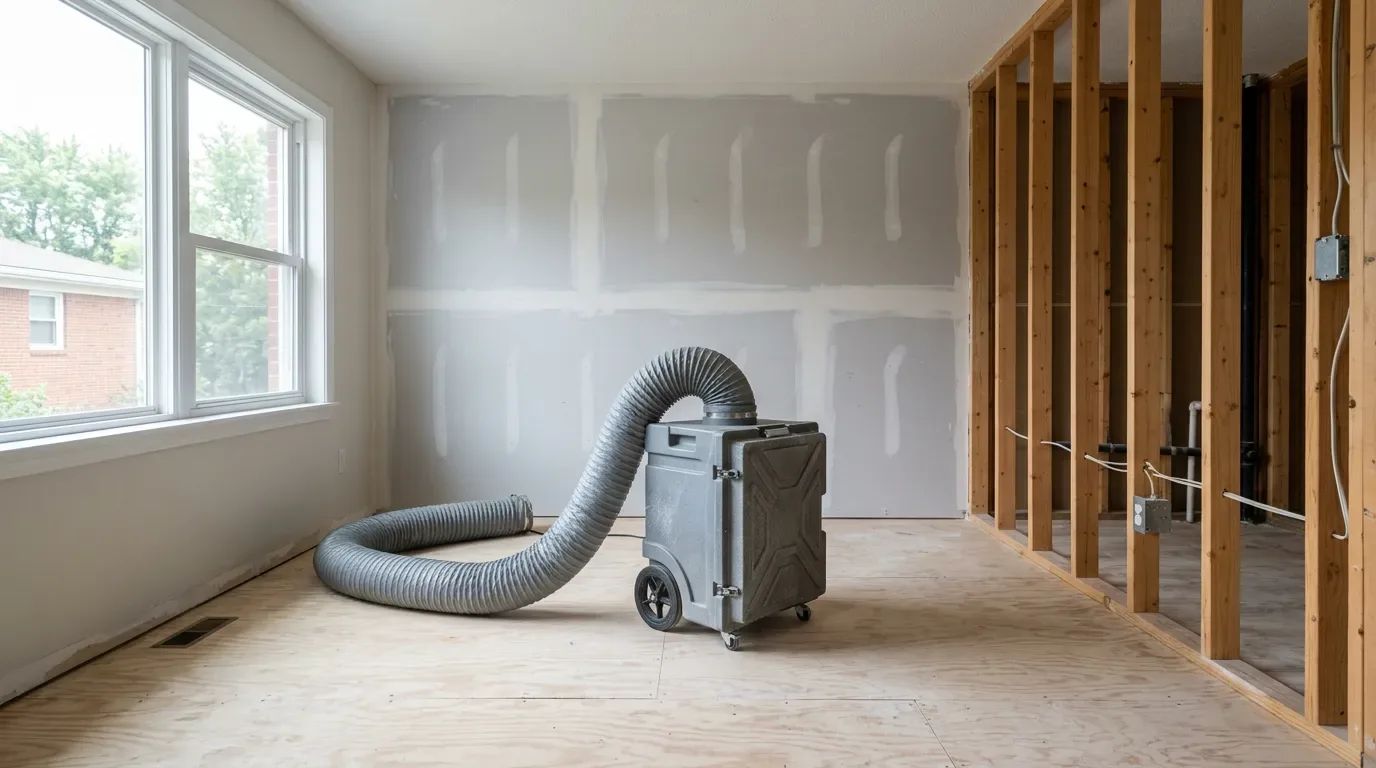
After an antimold treatment the room should be aired out as the product label or the crew directs. The wall itself needs to dry fully before finishing. After a flood, drying the whole home takes time, and fans and dehumidifiers speed it up. If the job followed a flood or a burst pipe, the drying is part of water damage restoration after a leak, and finishing should wait for it.
Smells after the work and when they are a problem
Chemical smell after mold remediation
An antimicrobial product is applied only in gloves, a respirator and goggles, and afterwards the room is aired out. A light chemical smell in the first hours is expected. Do not assume that the stronger the smell of a product, the better the treatment. For many hard surfaces, thorough washing with a suitable detergent and full drying afterwards is enough.
If you use a special antimold product yourself afterwards, you need to:
- Read the label before you start.
- Keep the stated concentration and do not make it stronger.
- Provide ventilation while you work and after.
- Not extend the contact time without need.
- Test the product on an inconspicuous area.
- Not apply several products one after another.
The main rule is never to mix different cleaning products. It is especially dangerous to combine bleach with ammonia, acids and other household chemicals: the reaction can produce toxic fumes.
Musty smell after mold remediation
A musty smell is most often found in bathrooms with poor ventilation. In that case a thorough cleaning is needed, wiping all surfaces, and after washing everything must be wiped dry. But the smell of dampness will not go away if mold is hiding somewhere.
A material should be removed and replaced, not just cleaned again, if it:
- Stayed wet for a long time.
- Has started to crumble or come apart in layers.
- Keeps a musty smell after drying.
- Is covered with mold on both sides.
- Darkens again after treatment.
A steady smell through the whole home is one of the signs that the problem is bigger than a small spot. Other warning signs are wet insulation, damage to load-bearing structures, mold coming back in several rooms at once, and mold inside the ventilation system. In such cases it is better to call in professional mold remediation in Del Mar than to keep washing walls.
Cleaning after mold remediation: what you can do yourself
Smooth, hard materials are usually easier to clean. Tile, glass, metal and some painted surfaces can be washed with water and detergent and then dried thoroughly. Porous materials are harder. Mold can go deeper than the visible spot, and if drywall, ceiling tiles, insulation, carpet or loose plaster are heavily affected, surface treatment may not give a lasting result.
After the work, the smell often stays in fabrics and in closets:
- Wash all household textiles: curtains, tablecloths, throws, pillowcases.
- Clean the upholstery of sofas and armchairs; in hard cases, call a cleaning service.
- Empty the closets and wash the clothes, then wash all the drawers and shelves inside.
- Air out books and other paper items outside, on a balcony or patio.
Expensive items, wooden structures and large affected areas are better shown to a pro than experimented on with harsh products. When a lot of furniture and belongings have to come out of the room, pack-out services for contents and belongings are one way to handle it.
Why you should not just paint over it
Mold gets into the structure of the material, so simply painting or patching the spot will not help. A fresh coat of paint can hide dark marks for a while, but it does not kill the mold inside the material. After some time the spot may show through again, and the coating may blister or start to peel. For the same reason, do not put new wallpaper over an affected area right away. The damp layer hidden under it will only slow the drying of the wall. The repair will look neat, but the problem will keep developing.
Keeping humidity down
The main rule to keep mold from coming back is to keep humidity and air circulation under control. Normally the humidity in a home should be kept below 50%. Mold appears when the humidity in a room stays high and the air does not move.
- Air rooms out on dry days. On foggy, damp days near the coast, a dehumidifier or the air conditioning does more than an open window.
- Run the exhaust fan. In the bathroom, turn it on while you shower and leave it running for a while after. Use the range hood while cooking and cover pots with lids where you can.
- Wipe up water after a shower. Remove water from the walls and the tub edges, and do not leave wet towels in a tight pile.
- Leave a gap behind furniture. Do not put wardrobes or a sofa tight against exterior walls, especially corner walls. There should be 2–4 inches between the back of the furniture and the wall for air to move.
- Measure humidity with a hygrometer if the home is always damp. This shows whether the problem is a single damaged spot or the general indoor climate.
After a leak, do not wait for a surface to dry on its own. Remove the water, get the air moving, use a dehumidifier if needed and check the materials next to it. Watch the caulk in the bathroom: if it has darkened from the inside, comes away from the surface or has lost its flexibility, the old layer is better replaced, after cleaning and drying the base first.
Can mold come back after remediation?
Mold does not appear in a home by chance. It needs moisture, and there can be many more sources of dampness than it seems at first glance. Sometimes the cause is obvious: a pipe leaks, the roof leaks, or an exterior wall gets wet after rain. In other cases the water is not visible. It can collect under the tub, behind a cabinet, behind the drywall or inside the structure. Often mold grows because of condensation: warm humid air touches a cold wall or window frame and turns into tiny drops. The surface may not look wet, but the constant dampness is enough.
Washing off a spot without removing the moisture is like wiping up a puddle and leaving the faucet open. Every few weeks, check:
- Corners of exterior walls and the area around windows.
- Walls behind large furniture.
- Seams around the tub and shower, and the bathroom ceiling.
- The area under the sink and near the washing machine.
- Closets, storage rooms and poorly ventilated nooks.
Run your hand over the surface, look at pipe joints, and pay attention to peeling or bubbling paint and a steady damp smell. If mold comes back on the same wall, the likely cause is a hidden leak, condensation or poor ventilation.
If a dark spot does come back, do not simply repeat the old treatment. Its return is an important hint: either the source of dampness has not been found yet, or the affected material was not fully cleaned. Success rests on three actions: find the water, remove the damage and make sure the area dries steadily.
Papers to keep
Keep a record of what was found and what was done, so that if a spot returns you know where to look first:
- The moisture source and how it was fixed: the pipe, the roof, the seal around the window.
- The materials that were removed and replaced, and where.
- Moisture readings taken before the final finish.
- Any sampling results, read with the EPA's note above in mind.
If you are still deciding who to work with, you can read reviews from local homeowners and learn more about the company. For the separate question of what mold does to people, see the guide on health risks of living with mold. More articles on water, fire and mold are in the blog's news section, and the services are listed on the Del Mar restoration company's home page.